
Operation Epic Fury
MN-06 Daily: February 28, 2026


The United States and Israel launched a joint military operation against Iran early this morning. President Trump announced “major combat operations” and called for regime change. Iran retaliated with missile strikes across the region — hitting Israel, Qatar, Kuwait, the UAE, and Bahrain. An Israeli strike reportedly hit an elementary girls’ school in Minab, killing at least 53 students. More than 200 people are reported dead across 24 Iranian provinces. Iran’s Revolutionary Guards have closed the Strait of Hormuz.
Rep. Emmer issued one tweet:
“This is a bold, decisive act of strength by President Trump. The Ayatollah is responsible for killing hundreds of U.S. service members and slaughtering its own people. We pray that because of this leadership, the U.S. and the world will be a safer place. May God bless and protect the men and women of our military conducting this mission and serving in the region.”
Today’s daily is different. We don’t have sourcing on military operations and we’re not going to pretend we do. What we can offer is what MN-06 Watch does best: context, timeline, and receipts. Because this didn’t start this morning. And the decisions that brought us here have a documented trail.
This Substack is reader-supported. To receive new posts and support my work, consider becoming a free or paid subscriber.
How We Got Here
The story of today’s strikes starts with a deal that was working.
2010-2013: The pressure campaign. By 2010, international sanctions on Iran were biting. Iran’s economy was cratering under the weight of UN, EU, and US sanctions targeting its oil exports, banking system, and trade. The pressure was designed to bring Iran to the negotiating table over its nuclear program — and it worked. In 2013, Iran elected Hassan Rouhani, a reformist who campaigned on engaging with the West. Secret backchannel talks between the US and Iran, facilitated by Oman, had already been underway since 2012.
2013-2015: The negotiations. What followed was one of the most complex diplomatic achievements in modern history. Over 20 months, the P5+1 — the United States, United Kingdom, France, Russia, China, and Germany — negotiated the Joint Comprehensive Plan of Action (JCPOA) with Iran. Secretary of State John Kerry and Iranian Foreign Minister Javad Zarif met on 18 different dates in 11 different cities. The talks became the longest continuous negotiations with all five permanent Security Council members’ foreign ministers present.
July 14, 2015: The deal. The JCPOA was signed. Under its terms, Iran agreed to reduce its stockpile of low-enriched uranium by 97% — from 10,000 kg to 300 kg — and limit enrichment to 3.67%, far below weapons-grade. Iran dismantled two-thirds of its centrifuges. The heavy water reactor at Arak, which could have produced plutonium for one or two weapons per year, was permanently redesigned. In exchange, nuclear-related sanctions were lifted.
The deal’s core achievement: Iran’s “breakout time” — the time needed to produce enough material for one nuclear weapon — went from approximately 2-3 months to more than a year. International inspectors gained unprecedented access. The IAEA confirmed repeatedly that Iran was complying with its commitments.
What the deal didn’t do: It didn’t address Iran’s ballistic missile program, its support for proxy groups like Hezbollah and Hamas, or its regional activities. Critics — including Israel, Saudi Arabia, and most Republicans in Congress — argued these omissions made the deal fatally flawed. Supporters argued that constraining the nuclear program was the essential first step, and that diplomacy could address other issues from a position of reduced nuclear risk.
September 2015: Congress votes. The House voted against approving the JCPOA, 162-269. Senate Democrats filibustered a disapproval resolution three times. The deal survived because President Obama had structured it as a political commitment, not a treaty — it didn’t require Senate ratification.
2016-2017: The deal holds. The IAEA verified Iranian compliance. Iran’s stockpile remained within limits. Inspectors maintained access. Breakout time held at over a year. The Trump administration itself certified Iran’s compliance twice in 2017 — in April and July — before reversing course.
May 8, 2018: Trump withdraws. Despite the compliance certifications, despite the objections of France, Germany, and the United Kingdom, and despite his own Secretary of Defense James Mattis and Secretary of State Rex Tillerson advising against it, President Trump withdrew the United States from the JCPOA. “This was a horrible, one-sided deal that should never, ever have been made,” he said. He reimposed all nuclear-related sanctions and added new ones under a “maximum pressure” campaign.
The stated goal: force Iran into a “better deal” that would also address missiles and regional behavior.
The result: no new deal.
2019-2023: The unraveling. Iran began exceeding JCPOA limits within a year of the US withdrawal. By 2021, its enriched uranium stockpile was 12 times the JCPOA cap. Enrichment reached 60% purity — far above the 3.67% limit, approaching the 90% needed for weapons. By early 2023, Iran’s breakout time had collapsed from over a year to approximately 12 days. Iran also began restricting IAEA inspector access.
The diplomatic architecture that had taken years to build was dismantled in months. The “better deal” never materialized.
2024: Israel-Iran direct conflict. Iran launched direct missile and drone attacks on Israel in April 2024 — the first such attack in history. Israel and allies intercepted most projectiles. Israel struck back. A second exchange followed in October. Meanwhile, Israel systematically degraded Iran’s regional proxy network: Hezbollah’s leadership was decimated, Hamas leaders were killed, and Assad fell in Syria. By year’s end, Iran’s regional influence had been severely diminished.
June 2025: The Twelve-Day War. The US and Israel launched joint strikes on Iran’s nuclear facilities and military infrastructure. Targets included Natanz, Fordow, and Isfahan. Trump announced the strikes had “obliterated” Iran’s nuclear program — a claim the IAEA later cast doubt on. Iran retaliated with missile strikes on the Al Udeid Air Base in Qatar, a major US military hub. Israeli officials later acknowledged their target selection was intended, in part, to destabilize the regime. Trump insisted on a ceasefire after twelve days.
January 3, 2026: Maduro captured. The US military launched Operation Absolute Resolve in Venezuela, capturing President Nicolás Maduro and extracting him to face narco-terrorism charges in New York. Trump declared the US would “run” Venezuela until a transition took place. The operation — regime change by military force against a sovereign nation — established a precedent that was not lost on the Iranian government.
Late December 2025 - January 2026: Iran erupts. Massive protests broke out across Iran beginning December 28, initially sparked by economic collapse — the rial had lost roughly half its value in 2025. They quickly became the largest uprising since the 1979 revolution, spreading to at least 78 cities. Protesters demanded not reform but regime change. The security forces responded with live fire. The confirmed death toll ranges from 3,117 (Iranian government) to over 7,000 (HRANA) to 32,000 (Trump administration’s claim).
January - February 2026: The US wades in. On January 2, Trump posted: “If Iran shots and violently kills peaceful protesters... the United States of America will come to their rescue. We are locked and loaded and ready to go.” On January 13, he went further: “Iranian Patriots, KEEP PROTESTING — TAKE OVER YOUR INSTITUTIONS!!! ...HELP IS ON ITS WAY.” Secretary of State Rubio posted: “The United States supports the brave people of Iran.” Iran experts noted that Trump’s warnings — coming from a president who had just removed Maduro by force — emboldened protesters while simultaneously giving the regime justification to blame outside interference for the unrest.
February 2026: The negotiations that almost worked. Indirect US-Iran nuclear talks resumed through Omani mediation in early February. Three rounds of negotiations took place. On February 27 — yesterday — Oman’s foreign minister announced a “breakthrough”: Iran had agreed to degrade its enriched uranium stockpiles to the lowest level possible, never stockpile enriched uranium again, and accept full IAEA verification.
February 28, 2026: Today. Less than 24 hours after that announced breakthrough, the US and Israel launched Operation Epic Fury. The strikes hit Tehran, Isfahan, Qom, Karaj, Kermanshah, and targets across 24 provinces. Trump called for regime change, telling Iranians to “take over your government.” Iran retaliated across the region. The Strait of Hormuz has been closed.
The Breakout Time Chart
This is the single most important metric for understanding what was gained and lost.
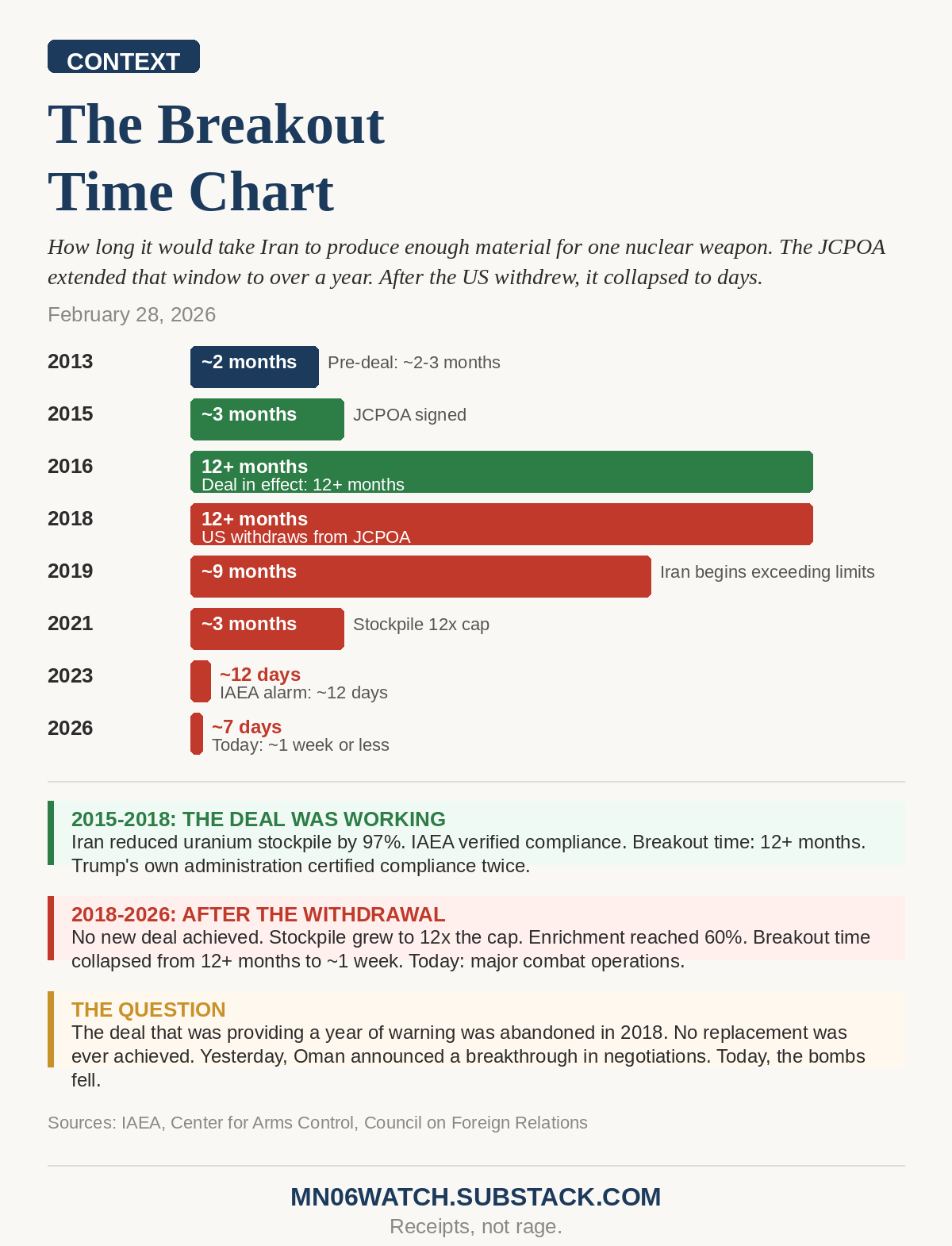
In 2016, the world had a verified year of warning before Iran could build a bomb. Today, that window may be measured in days. The deal that was providing that year of warning was abandoned in 2018. No replacement was ever achieved.
What MN-06 Needs to Know
This is an accountability journalism project, not a foreign policy analysis shop. But some things are worth noting for the people of Minnesota’s 6th Congressional District:
Military families. Camp Ripley, the Minnesota National Guard’s largest training facility, is in MN-06. Fort Snelling processes deployments. Military families across the district are watching this closely. “Major combat operations” are not an abstraction when your spouse or parent serves.
Economic impact. Iran has closed the Strait of Hormuz, through which roughly 20% of the world’s oil supply passes. If the closure holds, gas prices will spike. This will hit MN-06 — a sprawling suburban and rural district where people drive significant distances — directly.
The DHS shutdown continues. The United States launched combat operations in the Middle East today while the Department of Homeland Security is in Day 14 of a shutdown. 260,000 DHS employees are working without pay. Global Entry remains suspended. This is the security apparatus that is supposed to protect the homeland while military forces are deployed abroad.
The Medicaid freeze continues. $259.5 million in Medicaid funding remains frozen from Minnesota. The autism licensing deadline is still May 31. The prosecutor exodus from the Minnesota U.S. Attorney’s office has not been reversed. None of these issues have been resolved or even addressed by Rep. Emmer.
Congressional authority. The Constitution gives Congress the power to declare war. Congress has not authorized military operations against Iran. Members are preparing a war powers resolution. As Majority Whip, Emmer will play a central role in whether the House votes on that resolution — or buries it. His position on congressional war powers will matter more in the coming days than any tweet.
Emmer’s Record on Iran
Emmer has not been a prominent voice on Iran policy. His statement today — “a bold, decisive act of strength” — is the standard party-line response from House Republican leadership. It mirrors statements from virtually every GOP member.
What’s worth tracking going forward:
War powers: Will Emmer whip votes for or against a war powers resolution? Will the House vote on one at all?
Constituent communication: The district has military families. Will Emmer hold a town hall, a call, or issue a substantive statement beyond the initial tweet? As of today, it has been 934 days since his last in-person town hall.
Economic impact: When gas prices rise — and they will — will Emmer connect the dots to the policy decisions that led here, or will he blame someone else?
We’ve built a comprehensive dashboard tracking every member of Congress’s response to the Iran strikes, including predicted positions based on their voting records and public statements. That tool is here: Congressional Response Dashboard
What We’re Not Going to Do
We’re not going to pretend we know how this ends. We’re not going to offer military analysis we’re not qualified to give. We’re not going to use a war to score political points.
What we will do is what we always do: track what Rep. Emmer says, how he votes, and whether his actions match his words. If he votes on a war powers resolution, we’ll document it. If he doesn’t, we’ll document that too.
The Medicaid freeze, the prosecutor exodus, the autism licensing deadline, the DHS shutdown, the town hall counter — none of these go away because bombs are falling in Tehran. They’ll be here when the news cycle moves on. So will we.
934 days since Rep. Emmer’s last in-person town hall — August 9, 2023 — Hamburg, MN
DHS Shutdown: Day 14.
📊 MN-06 Watch Research Tools Vote Tracker • Tweet Archive • Transcripts
We document what your representative does. You decide what it means.
Subscribe to MN-06 Watch for daily accountability coverage of Rep. Tom Emmer.
📊 Source Data:
US Central Command statement on Operation Epic Fury, February 28, 2026
Washington Post live updates, February 28, 2026
NPR: “Panic, fury, and some hope, in Iran,” February 28, 2026
CNN: “Trump says ‘major combat operations’ underway,” February 28, 2026
Al Jazeera live updates, February 28, 2026
The Hill: “GOP lawmakers rally behind Trump after Iran strikes,” February 28, 2026
Wikipedia: “2026 Israeli-United States strikes on Iran” (live article)
Wikipedia: “United States withdrawal from the Joint Comprehensive Plan of Action”
Council on Foreign Relations: “What Is the Iran Nuclear Deal?”
Center for Arms Control and Non-Proliferation: “The Iran Deal, Then and Now”
Atlantic Council: Expert analysis, February 28, 2026
Congressional Response Dashboard: iran-analysis.netlify.app
Emmer tweet: @GOPMajorityWhip, February 28, 2026
 | A guest post by
|