
The Golden Age, Itemized
MN-06 Daily: June 3, 2026

On June 2, the Majority Whip’s office posted a number and a verdict. “WOW: 96% of filers receiving a tax cut this year earned less than $200,000,” Rep. Tom Emmer wrote, quoting a Treasury Department release. “The real winners of the @HouseGOP’s Working Families Tax Cuts are hardworking, everyday AMERICANS.”
The number is real. The question this Daily asks is a kitchen-table one: for a household in Minnesota’s Sixth District, what did that tax cut come to in dollars — and what happened to the cost of living over the same stretch of 2026? Below is the arithmetic, sourced and laid side by side.
MN-06 Watch is reader-supported accountability journalism. Primary sources, no paywall on the receipts. If the work is useful to you, a paid subscription keeps it going.
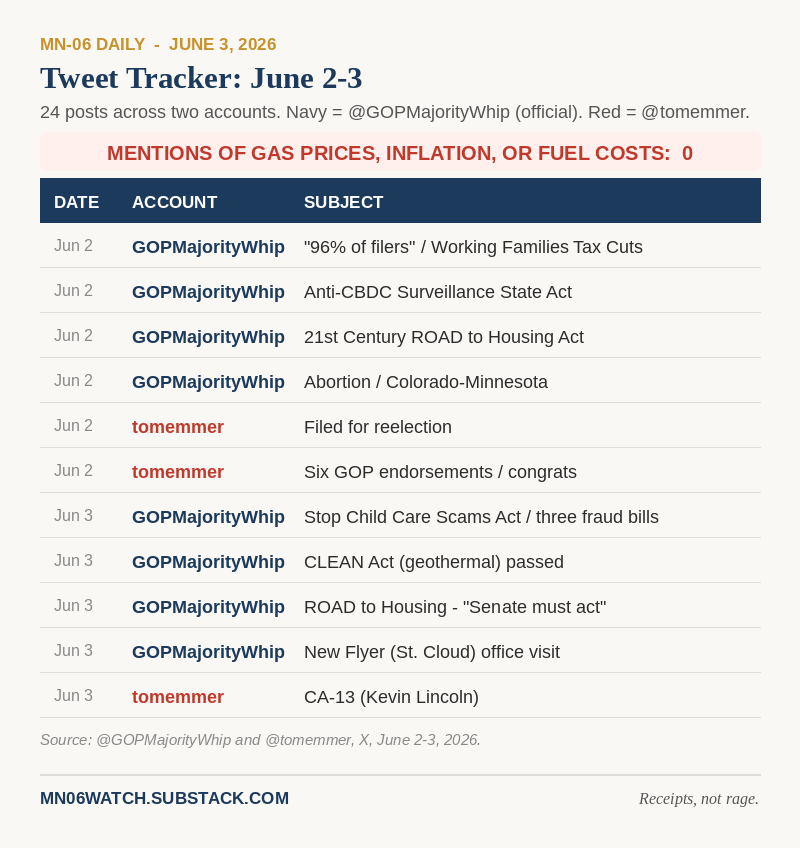
Activity, June 2–3: Tweets posted: 24 (15 @GOPMajorityWhip, 9 @tomemmer) · Media appearances: 1 (C-SPAN House Leadership Stakeout, June 3) · Floor: anti-fraud package previewed (see Around the District)
Town hall drought: 1,029 days since the last in-person town hall (Hamburg, MN — Aug. 9, 2023) Days to Election Day: 153
What He Tweeted
The June 2 post quote-tweeted the U.S. Treasury, which was promoting Secretary Scott Bessent’s analysis of the One Big Beautiful Bill Act’s tax provisions — branded by the administration as the “Working Families Tax Cuts.” Treasury’s headline figures: 97% of filers received a tax cut; of those, 96% earned under $200,000, and nearly 70% earned under $100,000.


Read literally, the statistic is accurate. It is also a count of people, not a measure of dollars — and the distance between those two things is the story.
What He Didn’t Mention
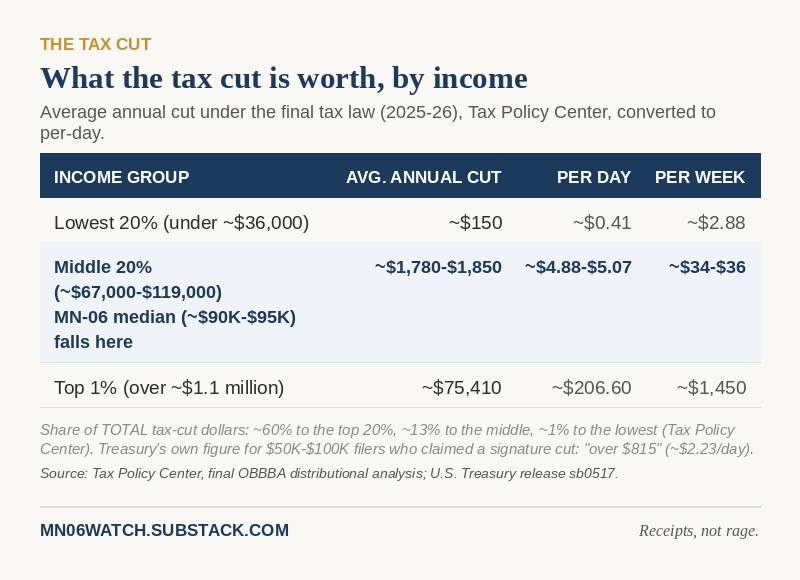
1. The dollars run to the top. Treasury’s stat measures how many filers got a cut. It does not measure how much of the cut went where. The nonpartisan Tax Policy Center’s analysis of the final bill found that nearly 60% of the total tax-cut dollars flow to the top 20% of earners (roughly $217,000 and up), with about 13% going to the middle and roughly 1% to the lowest-income filers. CBS News summarized the same distribution plainly: about $6 of every $10 in tax breaks goes to the top fifth of households. “96% of filers” and “where the money went” are two different sentences.
2. The “golden age” has a date stamp. On January 21 — the first anniversary of the inauguration, and five weeks before the war — Emmer told the House Leadership Stakeout: “The golden age of America begins right now,” in the same remarks where he claimed Republicans had delivered “the largest tax cut in American history.” That is the benchmark he set. What followed is below.
3. The war he championed, the cost he named. On February 28, the U.S. and Israel launched Operation Epic Fury against Iran. Emmer called it “a bold, decisive, and necessary act of strength against a belligerent and ruthless enemy of freedom” (March 4). Days later, asked about the economic fallout, he conceded the point directly: there would be “some temporary effects on our domestic economy,” which he framed as “a short-term cost to pay for a major long-term gain” (CNBC, March 9). The short-term cost is running on three months.
4. His own Treasury connected the dots. In the Treasury Department’s Q2 2026 statement to its Borrowing Advisory Committee, the administration touted “solid household consumption growth” while acknowledging, in writing, “elevated price levels associated with the Iranian conflict” and “energy costs due to the Iran conflict nudging headline inflation.” The administration that Emmer celebrates ties the price increases to the war that Emmer celebrates. The same statement claimed “worker wages continue to outpace inflation.” Bureau of Labor Statistics data for April 2026 shows the reverse: real average hourly wages fell 0.3% over the year.
5. “Credit card spending is through the roof.” On May 6, White House National Economic Council Director Kevin Hassett described that consumer spending on Fox Business — crediting Bessent’s framing — as “through the roof,” and named the cause in the same breath: Americans are “spending more on gasoline, but they’re spending more on everything else, too.” Total U.S. household debt stood at a record $18.8 trillion in the New York Fed’s most recent (Q1 2026) report, which describes a widening split as lower-income households strain. The administration offered rising spending as evidence of strength; the figures behind it are higher prices and more borrowing.
The Arithmetic
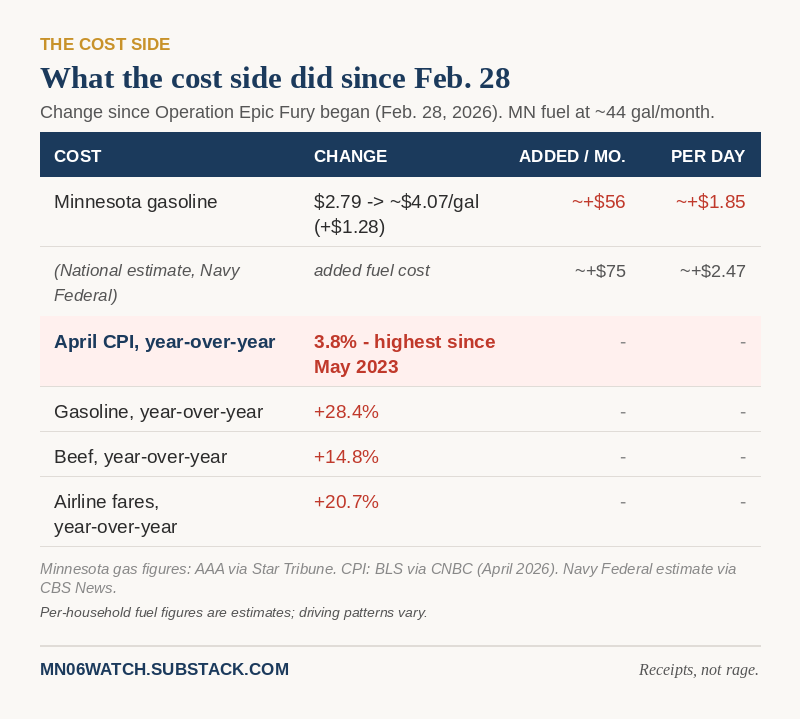
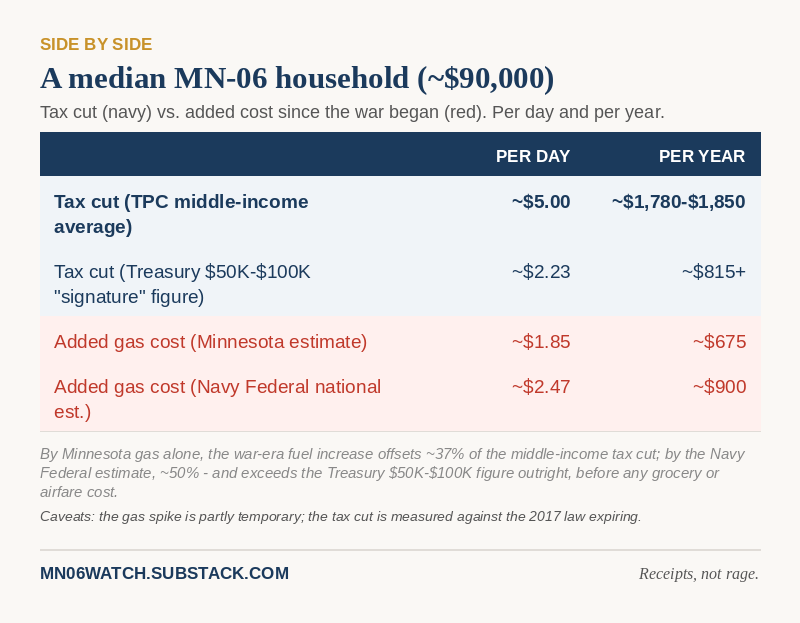
By Minnesota gas prices alone, the war-era fuel increase offsets roughly 37% of the middle-income tax cut; by the Navy Federal estimate, roughly 50%. By either measure, the added fuel cost exceeds Treasury’s $50K–$100K “signature-cut” figure outright — and gas is only one line on the receipt.
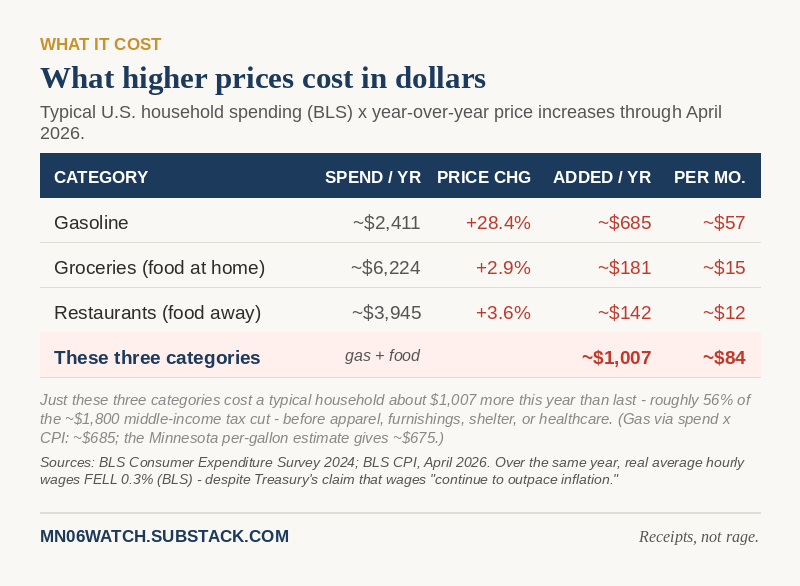
Gasoline and food alone cost a typical household about $1,007 more this year than last — roughly 56% of the ~$1,800 middle-income tax cut — before apparel, household furnishings, shelter, or healthcare are counted. (The grocery figure reflects food-at-home prices up 2.9% year-over-year, the steepest since August 2023; the USDA and food-industry groups attribute part of the rise to higher energy costs tied to the conflict.)
Two caveats belong on the table. The gas spike is partly temporary; prices are expected to ease if the Strait of Hormuz fully reopens, while much of the tax cut is permanent. And the tax cut is measured against the counterfactual of the 2017 tax law expiring — so a household comparing this year to last may not “feel” $1,800 in relief at all. The honest reading is that the two figures are the same size: the cost of buying the same gas and groceries took back more than half of the relief, and the war Emmer championed drove the largest single piece of it.
Tweet Tracker, June 2–3
Around the District
At the June 3 House Leadership Stakeout, Emmer previewed an anti-fraud agenda for the week — a package on child-care fraud (citing Minnesota’s “Quality Learning Center” case), changes to the TANF program, and a “No Aid for Fake Students” measure — and tied Minnesota’s fraud cases to Gov. Tim Walz, Attorney General Keith Ellison, and Rep. Ilhan Omar. The bills were described as forthcoming floor business; we’ll track the roll calls as they post.
On the same day, Emmer’s office promoted House passage of the bipartisan CLEAN Act on geothermal energy and continued to press the Senate on the ROAD to Housing Act.
Know someone in Minnesota that you’d like to share this with?
Who is the congressman talking to?
He set the benchmark himself in January: a golden age, beginning “right now.” Five months later, the receipts for a median MN-06 household show a tax cut of about five dollars a day — and a gas-and-grocery bill that has taken back more than half of it, with the Treasury currently headed by the GOP naming the war as the reason prices rose and his own wage data showing paychecks falling behind.
For the household doing this math at the kitchen table, did the golden age arrive — or did it get charged to the card?
Five Questions to the Congressman’s Office
Submitted via official contact form, June 3, 2026. We are still awaiting a response to all previous submissions.
Treasury reports that 96% of filers receiving a cut earned under $200,000. Does the congressman dispute the Tax Policy Center’s finding that roughly 60% of the law’s total tax-cut dollars go to the top 20% of earners?
On January 21 the congressman said “the golden age of America begins right now.” Since then Minnesota gasoline has risen from about $2.79 to about $4.07 a gallon and April CPI reached 3.8%, the highest since May 2023. Does he stand by the “golden age” characterization for his constituents today?
The congressman called Operation Epic Fury “a bold, decisive, and necessary act of strength” and acknowledged “some temporary effects on our domestic economy.” How long does he expect those effects to last, and what is his estimate of the per-household cost in MN-06?
NEC Director Kevin Hassett said credit card spending is “through the roof” because Americans are “spending more on gasoline” and “everything else.” With household debt at a record $18.8 trillion, does the congressman regard rising credit card spending as a sign of household strength?
When will the congressman hold an in-person town hall in MN-06? His last was 1,029 days ago.
🔗 MN-06 Watch Tools: Vote Tracker • Bills • Transcripts • Tweets • Articles
We document what your representative does. You decide what it means.
Subscribe to MN-06 Watch for daily accountability coverage of Rep. Tom Emmer.
Sources
Rep. Tom Emmer (@GOPMajorityWhip), tweet, June 2, 2026 (”96% of filers…”).
U.S. Department of the Treasury, “New Analysis: The Working Families Tax Cuts…,” release sb0517 (May/June 2026); home.treasury.gov.
U.S. Department of the Treasury, Economic Policy Statement to the Treasury Borrowing Advisory Committee, Q2 2026, release sb0486; home.treasury.gov.
Tax Policy Center, “TPC Finds Final House Budget Bill Cuts Average Taxes By $2,900, Mostly For High-Income Households,” taxpolicycenter.org.
CBS News, distribution of OBBBA tax cuts (”$6 of every $10… top 20%”).
Federal Reserve Bank of New York, Quarterly Report on Household Debt and Credit, Q1 2026 (May 12, 2026); newyorkfed.org.
CNBC, “Consumer prices rose 3.8% annually in April…,” May 12, 2026.
U.S. Bureau of Labor Statistics, Consumer Expenditure Survey 2024 (released Dec. 19, 2025); bls.gov/cex.
USDA Economic Research Service, Food Price Outlook (food-at-home +2.9% YoY, April 2026); BLS CPI detail (gasoline +28.4%, airfare +20.7%, food away +3.6%).
BLS, Real Earnings, April 2026 (real average hourly earnings −0.3% over the year).
Star Tribune, Minnesota gas prices since the Feb. 28 strikes; AAA data.
CNBC, “U.S. gas prices hit $4 per gallon…,” March 31, 2026; CBS News (Navy Federal $75/month estimate).
Office of the Majority Whip, “Whip Emmer Commends Operation Epic Fury…,” March 4, 2026; majoritywhip.gov.
CNBC, Emmer on Iran-war economic effects, March 9, 2026.
CNN / Mediaite / U.S. News, Kevin Hassett, “credit card spending is through the roof,” Fox Business, May 6, 2026.
Rep. Tom Emmer, House Leadership Stakeout, C-SPAN, January 21, 2026 (”the golden age of America begins right now”) and June 3, 2026 (anti-fraud preview).