
The Missing Word
MN-06 Daily: July 6th, 2026

He amplified a New York Post headline blaming immigration for a “30% rise in home prices.” The Federal Reserve paper underneath it says something four times smaller — and a conservative writer was among the first to say so.
This Substack is reader-supported. To receive new posts and support my work, consider becoming a free or paid subscriber.
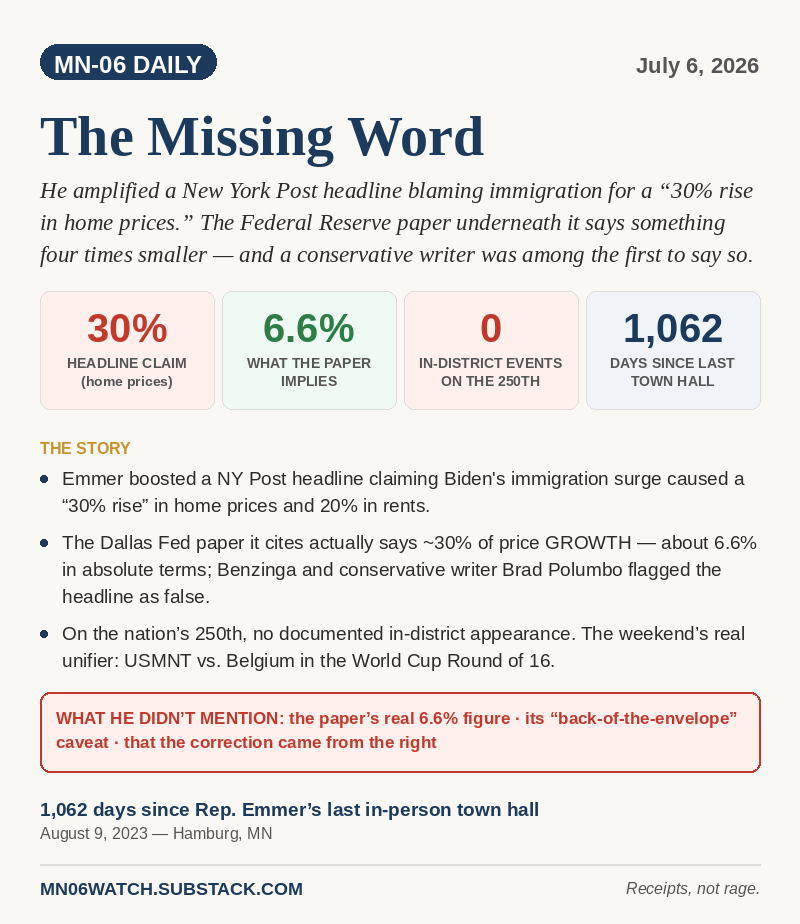
10 tweets. 0 media appearances. 0 votes. 1 amplified headline overstating its own Fed source by roughly 4x. 0 mentions of the 6.6% the paper actually implies.
1,062 days since Rep. Emmer’s last in-person town hall — August 9, 2023 — Hamburg, MN
The Missing Word
On Saturday morning, Rep. Tom Emmer boosted a New York Post headline from his official @GOPMajorityWhip account and added a verdict: “Just another example of why the Biden administration’s open border, pro-illegals agenda was a massive failure.”


The headline he amplified reads: “Biden’s illegal immigration surge triggered 30% rise in home prices, 20% in rents, Fed paper finds.”
The Federal Reserve paper it cites does not say that. The gap between the headline and the paper is one small, but important missing word: of.
The study is a Federal Reserve Bank of Dallas working paper — number 2607, by Daniel Wilson of the San Francisco Fed and Xiaoqing Zhou of the Dallas Fed, dated March 6, 2026. It estimates that the surge in unauthorized immigration during 2021–2024 can explain roughly 30% of the growth in home prices and 20% of the growth in rents for the average metro area over that period.
That is not the same as a 30% rise. The paper reports that total home prices grew 22.4% and rents grew 22.6% across the years it studies. Thirty percent of a 22.4% increase is about 6.6%. Twenty percent of a 22.6% increase is about 4.5%. Those are the figures the paper’s own arithmetic supports as the immigration-attributable share — not the 30% and 20% in the headline, which are roughly four times larger. “Thirty percent of the increase” and “a 30% increase” are substantially different. The headline from the Post collapsed the first into the second.
This is not a partisan reading either. The writer who first flagged the headline as false, Brad Polumbo, is a conservative journalist rated “lean right” — he put the real effect near 6.6% on prices and about 4.3% on rents. The financial outlet Benzinga ran the same arithmetic independently and landed in the same place: an implied effect of roughly 6.6% on average home prices, rather than a flat 30% rise in the baseline cost of a home. Even President Trump’s own post on the paper described it as “30% of home price growth” — the accurate framing — which places the distortion squarely in the Post’s headline and in the accounts that repeated the headline’s version rather than the paper’s.
To be clear about what the paper does support: it finds a real, measurable effect. A 6.6% contribution to home prices in the average metro is not nothing, and the study is a serious piece of research into how the 2021–2024 surge moved housing costs. Emmer’s underlying claim — that the surge affected housing — has support in the document. What it does not support is the magnitude in the headline he amplified.
A few things the paper says about itself that the headline left behind: it is a preliminary working paper circulated for professional comment, not an official Fed position; the authors call the 30%/20% split a “back-of-the-envelope calculation”; the estimates describe the average local market, not the nation; and the measured effect on local wages was too imprecise to distinguish from zero. Separately, FactCheck.org concluded in December that recent home-price increases were driven primarily by mortgage rates — which more than doubled over Biden’s term — and a long-standing housing supply shortage, with immigration one factor among several.
Emmer did not write the “30%” himself, but he did amplify a headline that misstates the paper beneath it. The paper’s real finding is worth a serious argument on its actual terms. The question is whether boosting a fourfold overstatement advances that argument or makes it impossible for anyone who sees the overstatement to engage with the argument at all.
On the Fourth
This Fourth of July was the country’s 250th birthday, and Emmer marked it the way he marks most things now: online. Both accounts posted anniversary greetings — “the greatest nation the world has ever known,” “our brightest days are still ahead.” We found no record of an in-person appearance anywhere in the district — no parade, no festival, no constituent event in Anoka, Sherburne, Wright, Benton, Carver, or Stearns counties. On the single most unifying civic day on the calendar, in the district he represents, the Whip was a set of posts. Doug Chapin spent the weekend at parades in Delano and Chanhassen. Mike Foley was also at the Delano parade.
We wrote last week (”The Example at the Top”) about the cues leaders send on days like this — that a 250th anniversary is a chance to say the country belongs to all of us, and that leaders set the temperature for whether it feels that way. The example from the very top on Saturday ran against the unifying hope we have for our leaders. In his “Salute to America 250” address on the National Mall, President Trump used the traditionally unifying Independence Day platform to stump for his proof-of-citizenship elections bill and to warn of communism as a “mortal threat” — a turn news outlets described as unusually partisan for the occasion, a departure from the apolitical Fourth of July addresses presidents like Ford and Reagan once delivered. (We’ve written before about the elections bill; see our SAVE Act explainer.)
Emmer’s weekend feed echoed that top — Trump Accounts, tax-cut anniversaries, the border — more than it echoed a unifying message. On the day meant to gather everyone under one flag, his public-facing work pointed at Washington, not Blaine, not Andover, not Delano, not Buffalo nor any other community in the sixth district of Minnesota.
One Flag, Ninety Minutes
There was a genuinely unifying thing happening this weekend — and for the past couple of weeks — and, to his credit, Emmer pointed at it. "Good luck to the @USMNT tonight!" he posted today.

Tonight the U.S. men’s national team plays Belgium in the Round of 16, at Lumen Field in Seattle, in a World Cup the United States is hosting in its 250th year. The Americans got here by beating Bosnia and Herzegovina 2-0 — their first World Cup knockout win since 2002. The team's leading scorer is Folarin Balogun, a 25-year-old born in Brooklyn who plays club football for Monaco; he is eligible to wear the shirt because he was born here. Neither of his parents was an American citizen, and — as his mother, Florence, recounted to ESPN — an airline wouldn't let her board her flight home to London when she was seven months pregnant, so he was born in Brooklyn.
For ninety minutes tonight, a lot of Americans who agree on nothing else will stand for the same anthem and pull for the same eleven players. Nobody in that stadium or watching at home will be checking whether the person next to them boosted the right headline or the wrong one. That is the thing about a national team: it belongs to all of us at once, without an argument, for as long as the match lasts.
We spend most of these Dailies documenting where the record and the rhetoric come apart. It is worth saying plainly, on a weekend like this one, that the country the team represents is bigger than any week’s talking point — and that the impulse to celebrate it together is the same impulse that ought to survive the day after the whistle. Go USA.
What He Actually Did
A “district work period” is Congress’s own term for the weeks it sets aside for members to be home — in the district, in front of constituents. The House was in one all weekend, with the next floor votes scheduled for July 13. Measured against what the week is for, the public record is thin: as of today, Emmer’s official site lists no upcoming in-district events; his mobile office hours page is blank and, by its own note, run by staff rather than the congressman (”While I will not be at these events, my staff will be able to help you!”); and St. Cloud LIVE reported earlier this year that his office didn’t respond to repeated questions about town halls and that none were posted. His documented substitute for the in-person forum is the telephone town hall — he held two in 2025, dialed in from Washington.
The Washington calendar fills back in more readily. He returns Monday as Majority Whip to a stalled agenda — the defense authorization bill and a national-security spending package both went down on the floor June 30 when a bloc of Republicans sank the procedural vote, and reviving them runs through the whip operation he leads. On the day set aside for the district, the schedule that reappears is the one in D.C.
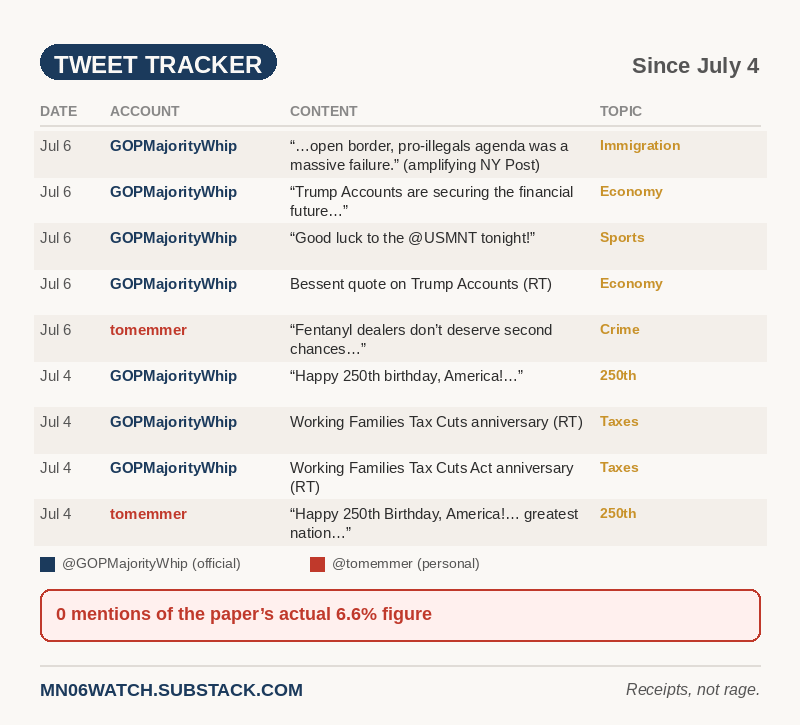
Over the weekend itself we found no in-district public events, media appearances, or press releases. The weekend’s public-facing record is the feed below.
What He Tweeted
What He Didn’t Mention
That the paper he amplified puts the immigration-attributable share of home-price growth at about 6.6%, not 30%.
That the 30%/20% figures come from an author-labeled “back-of-the-envelope” estimate in a preliminary working paper that is not an official Fed position.
That a conservative writer, not a critic on the left, was among the first to flag the headline as false.
That mortgage rates and a long-running housing supply shortage are the larger drivers economists point to.
Any in-person plan to mark the 250th with the constituents he represents.
The Questions
We submitted the following five questions to Rep. Emmer through his official contact form.
The Dallas Fed paper your account amplified attributes roughly 6.6% of the average metro’s home-price increase to the immigration surge, not a 30% rise. Will you correct the figure your account boosted?
The paper’s authors label the 30%/20% split a “back-of-the-envelope” estimate in a preliminary working paper that does not reflect the Fed’s official view. Does your office distinguish working papers from Federal Reserve findings before amplifying them?
FactCheck.org attributes recent home-price increases primarily to mortgage rates and a long-standing housing supply shortage. Do you accept those as significant factors alongside immigration?
What has the House done under your whip operation this Congress to address the housing supply shortage economists identify as a leading driver of home prices?
It has been 1,062 days since your last in-person town hall in the district. Will you hold one in MN-06 before the August recess?
We are still awaiting a response to all previous submissions.
This Substack is reader-supported. Share it with someone in MN-06.
📊 Source Data:
Rep. Emmer, @GOPMajorityWhip housing post and @tomemmer, X, July 4–6, 2026
New York Post, @nypost headline, July 5, 2026
Federal Reserve Bank of Dallas, Working Paper 2607 (Wilson & Zhou, March 6, 2026)
Benzinga, July 6, 2026
FactCheck.org, “Vance’s Misleading Claims on Housing Prices and Illegal Immigration,” December 8, 2025
PBS NewsHour and NPR, July 3–4, 2026 (Trump “Salute to America 250” and Mount Rushmore addresses)
ESPN and Al Jazeera, July 5–6, 2026 (USMNT Round of 16)
U.S. House Press Gallery, 2026 House calendar
🔗 MN-06 Watch Tools: Vote Tracker • Bills • Transcripts • Tweets • Articles
We document what your representative does. You decide what it means.
Subscribe to MN-06 Watch for daily accountability coverage of Rep. Tom Emmer.