
The Signing That Wasn't
MN-06 Daily: June 24, 2026

At noon today, President Trump was scheduled to sign the most significant federal housing bill in a generation at the Capitol. The flags were up in Statuary Hall. Tom Emmer’s leadership team was on stage touting the bill. And then the President posted that the signing was “hereby cancelled” — until Congress passes a separate election bill he’s now calling a national emergency. As of this writing, the Majority Whip has not said a word about it.
This Substack is reader-supported. To receive new posts and support my work, consider becoming a free or paid subscriber.
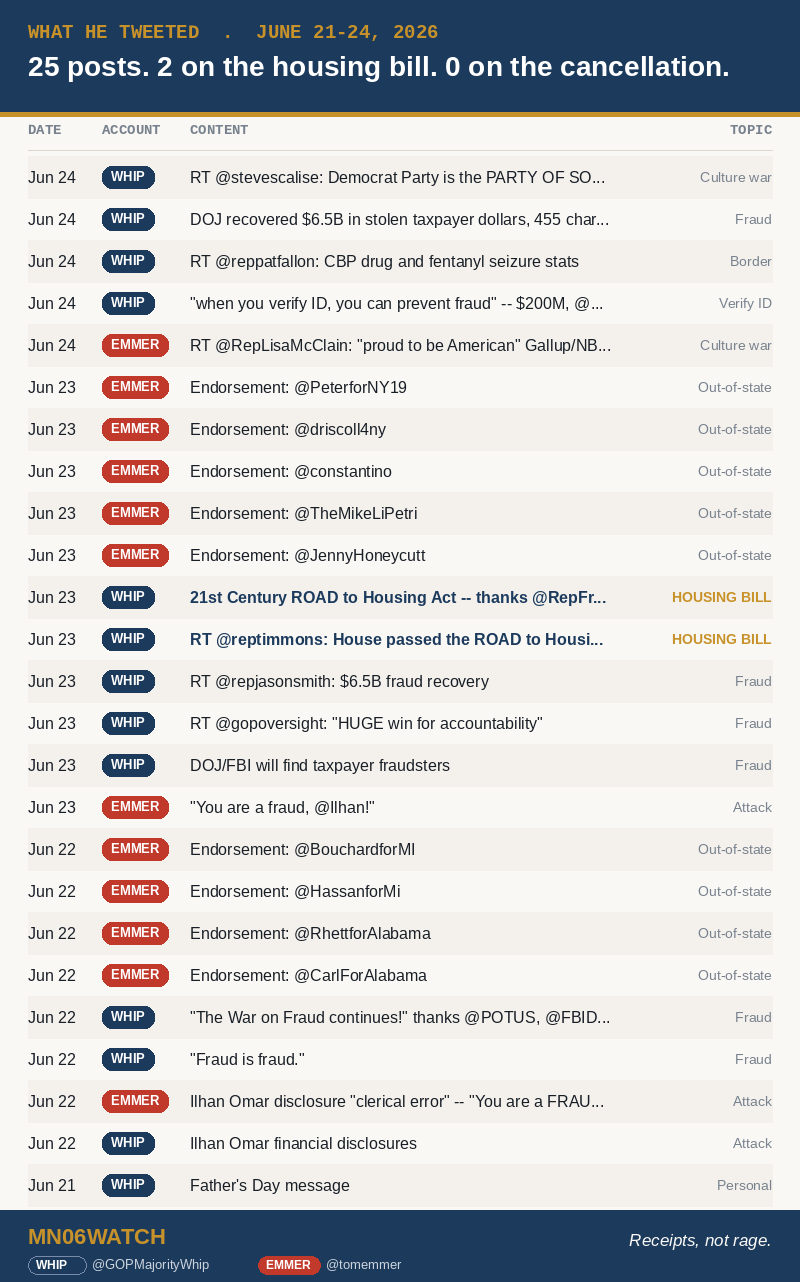
25 tweets. One stakeout appearance. Two posts about the housing bill — both dated yesterday, before the signing was pulled. Zero words about the cancellation.
1,050 days since Rep. Emmer’s last in-person town hall — August 9, 2023 — Hamburg, MN.
The Split-Screen
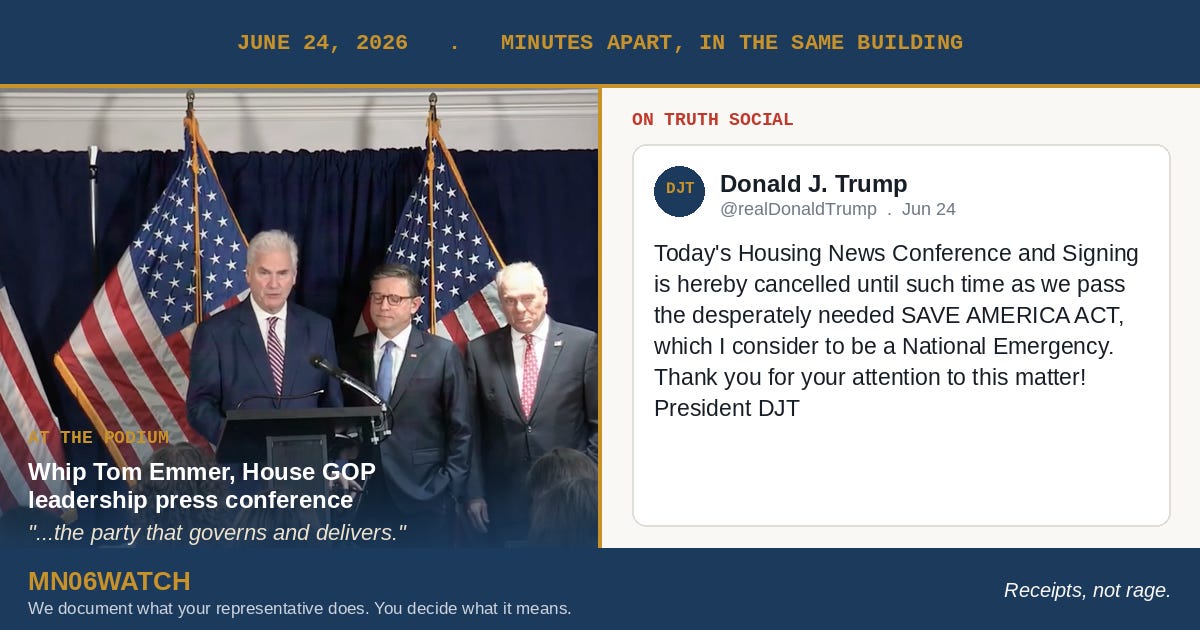
Here is the sequence, as it happened on Wednesday morning.
The White House had announced that President Trump would sign the 21st Century ROAD to Housing Act (H.R. 6644) in Statuary Hall at noon. Press Secretary Karoline Leavitt had called it, the night before, one of the most significant housing-affordability bills in American history. (More on Emmer’s affordability stances here). The presidential seal and roughly a dozen flags were already in place.
At the same time, House Republican leadership held its weekly press conference to tout the bill. Majority Whip Tom Emmer spoke. Per the transcript MN-06 Watch produced from the C-SPAN feed, he closed his remarks this way:
“House Republicans are going to be the party that governs and delivers because that’s what the American people sent us here to do.”
The bulk of his statement was about appropriations — not housing. He talked about Republicans passing funding bills “on time,” and he pre-assigned blame for any future shutdown:
“So if there’s a government shutdown after September 30th this year, it will once again be entirely on Democrats. Republicans are doing the work we were hired to do. And we’re on track to get all 12 appropriations bills done on time this time.”
While leadership was on stage, the President posted to Truth Social:
“Today’s Housing News Conference and Signing is hereby cancelled until such time as we pass the desperately needed SAVE AMERICA ACT, which I consider to be a National Emergency. Thank you for your attention to this matter! President DJT”
Reporters in the room documented the timing. Axios noted that Financial Services Chairman French Hill praised the bill “mere minutes before the president’s post.” Punchbowl’s Jake Sherman wrote that GOP leadership was “literally on stage right now touting the bill.” The signing was scrapped; the flags were packed away.
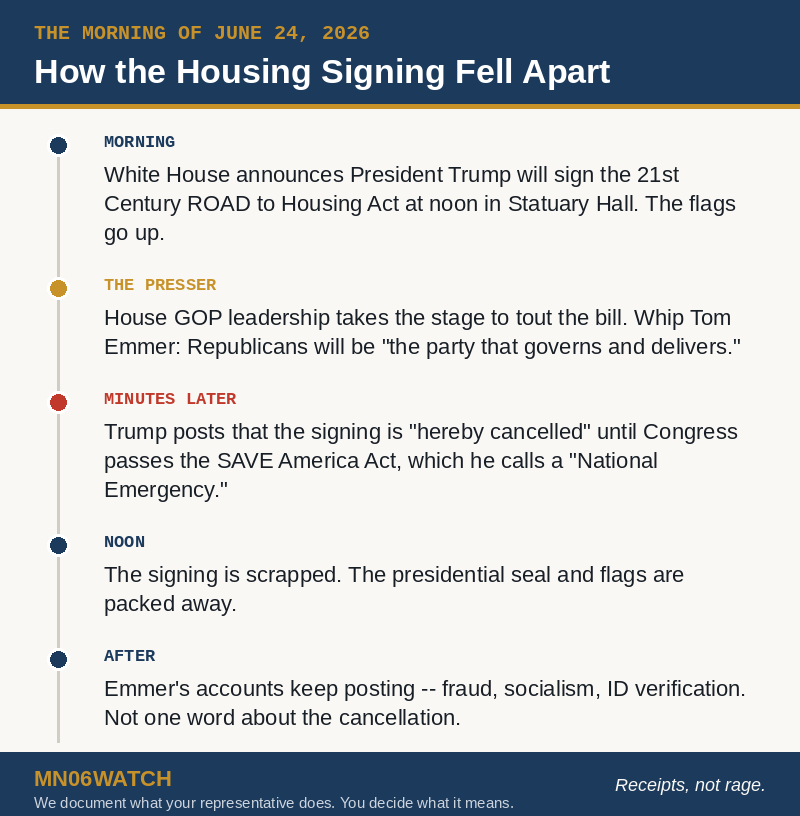
The on-record Republican response came from Speaker Mike Johnson, who told reporters the President was “delaying” the signing to pursue his voter-ID priority and “has a window of time before he has to sign a bill.” Hill told CNBC the President “picked the day, and now he’s chosen to change the day. So we’ll let him do that.”
Emmer’s name does not appear in the coverage responding to the cancellation. His office published his appropriations remarks. It has not published anything about the housing bill being pulled. The previous day, Rep Emmer posted twice promoting the passage of the bill.

What the Housing Bill Actually Does
The bill Trump declined to sign is not a partisan measure. The Senate passed the final text 85–5 on June 22. The House agreed 358–32 on June 23 (Roll Call 224), under suspension of the rules, which requires a two-thirds majority. Every recorded “no” vote came from a Republican; Democrats voted for it unanimously. It is widely described as the most significant federal housing legislation since 1990.
What it does, on the merits: it aims to increase housing supply and lower costs by streamlining federal environmental review for certain housing construction, encouraging local zoning and permitting reform, modernizing HUD’s HOME program, raising FHA multifamily loan limits, and removing the permanent-chassis requirement for manufactured homes. It also bars large institutional investors from buying single-family homes — a section titled “Homes are for people, not corporations.”
The affordability problem it’s aimed at is not abstract in MN-06. According to Redfin, a household needs roughly $117,000 a year to afford the typical U.S. home on the market — about $30,000 more than most households earn. Realtor.com estimated the country is short more than 4 million housing units. The 30-year fixed mortgage averaged 6.47% as of June 18 (Freddie Mac).
In Minnesota, the National Low Income Housing Coalition’s 2026 Gap report counts only 41 affordable and available homes for every 100 extremely low-income renter households — a shortage of roughly 97,500 homes statewide. The statewide median sale price was about $358,717 in April. In Anoka County — the population center of the Sixth District — the average sale price over the past year ran about $366,251, with homes moving in roughly 40 days. A Housing Affordability Institute report found that more than half of Minnesota households can no longer afford the median cost of a previously owned home.
On the manufactured-housing provision specifically, a NerdWallet lending expert told NPR that removing the chassis requirement can cut “several thousand dollars” off the price of a home — an estimated $5,000 to $10,000 per unit.
That is the bill. It passed both chambers with veto-proof margins and went to the President’s desk.
The Hostage
The bill Trump is demanding in exchange is the SAVE America Act (H.R. 7296 / S. 1383), the election measure requiring documentary proof of citizenship to register and photo ID to vote in federal elections.
We have covered this bill in depth before. The short version: the House passed it 218–213 on February 11, almost entirely along party lines. Tom Emmer voted yes and is a cosponsor. It is stalled in the Senate, where it needs 60 votes to overcome a filibuster. Republicans hold 53 seats. Majority Leader John Thune has said repeatedly his members are not willing to abolish the filibuster to lower that threshold.
Trump has now tied a popular, bipartisan housing bill to a stalled, party-line elections bill — and called the elections bill a “National Emergency.” Roll Call notes he has made the same threat before, on other legislation, without holding firm to it.
The constitutional mechanics limit the standoff. Under Article I, a bill becomes law if the President neither signs nor vetoes it within ten days (excluding Sundays) while Congress is in session. Both chambers passed the housing bill with more than the two-thirds needed to override a veto. Speaker Johnson predicted Trump would sign within the window. Senate Democratic Leader Chuck Schumer said the votes likely exist to override a veto if it came to that.
What the SAVE Act would actually require, who it would affect, and the gap between the polling Emmer cites (83% support for “photo ID”) and the polling he doesn’t (28% support for “the SAVE Act” by name, per CBS News/YouGov) — all of that is documented in our full explainer at mn06watch.com/articles/save-act-explainer, along with a model alternative, the Election Integrity Standards Act, at mn06watch.com/articles/eisa-framework.
The Provision With His Name On It
There is a piece of this story that runs directly through the Sixth District’s representative.
Tucked inside the housing bill is a prohibition on the Federal Reserve issuing a central bank digital currency (CBDC) — a government digital dollar — running through December 31, 2030. Multiple outlets covering the bill (CoinDesk, crypto.news, Tech Times, and others) credit that language as reviving the Anti-CBDC Surveillance State Act, which Tom Emmer authored. Emmer’s standalone version passed the House 219–210 in July 2025 and never cleared the Senate. Folding it into a must-pass housing bill gave it a vehicle.
Emmer is co-chair of the Congressional Crypto Caucus and Vice Chair of the Financial Services Subcommittee on Digital Assets, Financial Technology and AI. He has framed a Fed CBDC as a surveillance threat, comparing it to the tool “the Chinese Communist Party uses to surveil and control its people.”
So the bill the President just stalled carries Emmer’s signature policy issue inside it.
The Leverage Specialist
Using one bill as leverage for another is not foreign to the Majority Whip. It is, by his own account, the job.
In a January 2026 profile, Emmer described to NBC News how he counts votes in a narrow majority and when he calls in the President to pressure reluctant members. “I don’t count Democrat votes,” he said. “You’re the only ones that I count, and you’re the only ones that matter to me.” A White House official in the same piece called Emmer the “tougher cop” to Johnson’s patient style.
His posture on the filibuster — the procedural wall now blocking the SAVE Act — has moved with the politics. In April 2021, he called modifying it a vehicle for “dangerous far-left legislation.” By 2026, with his own party’s bill stuck behind it, he has called on the Senate to “dispense with this 60-vote thing.” And this is not the first time the SAVE Act has been used as a lever: it has previously been attached to DHS shutdown funding and to a FISA reauthorization fight.
The throughline is documented and not in dispute: the Whip whose job is leverage watched the President apply leverage to his own leadership team’s marquee bill — and, as of this writing, has said nothing about it.
What He Tweeted
Twenty-five posts across both accounts since Sunday. Two mentioned the housing bill — both yesterday, before the signing was cancelled. None mentioned the cancellation.
What He Didn’t Mention
The two housing-bill posts both went up on June 23, celebrating passage. After the President cancelled the signing on June 24, the accounts kept posting — about a $6.5 billion fraud recovery, about socialism, about cartels, about student-loan ID verification — and said nothing about the bill being pulled from the President’s desk.
That fourth post is worth pausing on. At 1:00 p.m., roughly two hours after the cancellation, @GOPMajorityWhip posted: “when you verify ID, you can prevent fraud.” That is the core argument for the SAVE Act — the bill the President had just made the housing signing hostage to. The post connects ID verification to fraud prevention without mentioning the housing bill, the cancellation, or the SAVE Act standoff playing out in the same building, on the same morning.
Questions for the Whip
The following questions were submitted to Rep. Emmer’s office via his official contact form.
You spoke at the House Republican leadership press conference on June 24, the same morning the President cancelled the signing of the 21st Century ROAD to Housing Act. Do you support the President withholding his signature from a bill that passed the House 358–32 in order to pressure the Senate on a separate measure?
The SAVE America Act is stalled in the Senate, short of the 60 votes needed to overcome a filibuster. In April 2021 you described modifying the filibuster as a path to “dangerous far-left legislation.” Do you now support eliminating it to pass the SAVE Act, and if so, what changed?
The housing bill contains a ban on a Federal Reserve central bank digital currency — language reviving your own Anti-CBDC Surveillance State Act. Does the President’s decision to stall this bill affect a measure you authored, and have you raised that with the administration?
Your office posted about the housing bill on June 23 and about ID verification on June 24, but has not addressed the cancellation. Do you have a public position on whether the President should sign the housing bill within the ten-day constitutional window?
It has been 1,050 days since your last in-person town hall in the Sixth District — August 9, 2023, in Hamburg. With housing affordability central to this year’s election and a bill your leadership team championed now in limbo, will you hold an open, in-person town hall in MN-06 during the July–August recess?
We are still awaiting a response to all previous submissions.
This Substack is reader-supported. Share it with someone in MN-06.
🔗 MN-06 Watch Tools: Vote Tracker • Bills • Transcripts • Tweets • Articles
We document what your representative does. You decide what it means.
Subscribe to MN-06 Watch for daily accountability coverage of Rep. Tom Emmer.
📊 Source Data:
H.R. 6644, 21st Century ROAD to Housing Act — congress.gov/bill/119th-congress/house-bill/6644; House Roll Call 224 (358–32, June 23, 2026), clerk.house.gov; Senate vote 85–5 (June 22, 2026)
Trump cancellation post — Truth Social, June 24, 2026 (screenshot)
Emmer remarks, House Republican Leadership press conference — C-SPAN, June 24, 2026 (MN-06 Watch transcript); majoritywhip.gov, “Whip Emmer: House Republicans Are Restoring Order to the Appropriations Process”
Cancellation timing and leadership response — Roll Call, Axios, CNBC, NBC News, CBS News, Fox News, June 24, 2026
Housing affordability data — NPR (June 23, 2026); Redfin; Realtor.com; Freddie Mac PMMS (June 18, 2026); NerdWallet via NPR
Minnesota housing data — NLIHC The Gap 2026 via Minnesota Housing Partnership; Redfin (Minnesota, Anoka County, April 2026); Housing Affordability Institute via Minnesota Reformer
CBDC ban / Anti-CBDC Surveillance State Act — congress.gov; CoinDesk, crypto.news, Tech Times (June 2026); Emmer House vote 219–210 (July 17, 2025)
SAVE America Act — H.R. 7296 / S. 1383; House vote 218–213 (Feb. 11, 2026); Brennan Center; CBS News/YouGov (March 2026); Utah audit via Vote.org; MN-06 Watch SAVE Act Explainer and EISA framework
Emmer on whipping and leverage — NBC News, “How Whip Tom Emmer helped Trump flip the Republican script on spending bills,” Jan. 21, 2026
Emmer filibuster positions (2021, 2026) — MN-06 Watch archive; prior coverage
Tweets — @GOPMajorityWhip and @tomemmer, June 21–24, 2026